
In the deep and unpredictable marine environment, submarine cables are hailed as the "lifelines" of global energy and data transmission. However, the seabed is far from a tranquil place; powerful currents, violent waves, and frequent human activities constantly threaten the integrity of these cables. To ensure these kilometers of cabling can operate stably for decades, the Submarine Cable Protection System (CPS) was developed.
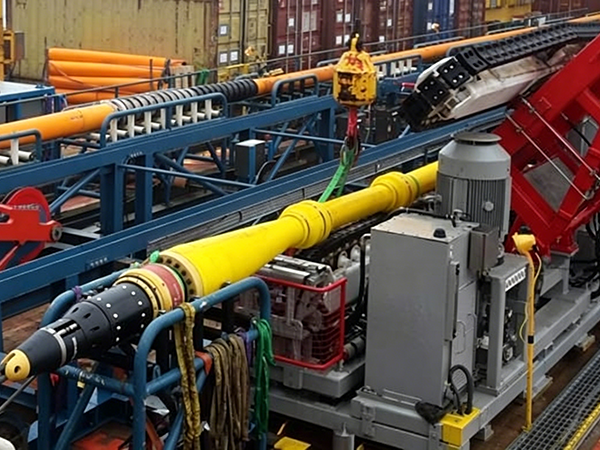
A complete CPS is not a single product, but a sophisticated suite of physical protection solutions. Below are the core components of the system and the technical logic behind them:
Core Components: Protection from Flexible to Rigid
1. Bend Restrictors
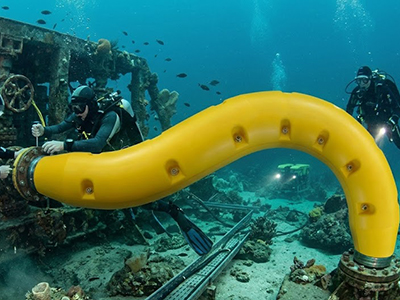
Bend restrictors act as the "backbone" of the CPS. They consist of a series of interlocking high-performance polyurethane half-shells, resembling segments of a spine.
Technical Principle: When external forces attempt to over-bend the cable, these interlocking components lock together to form a rigid mechanical barrier, forcing the cable to remain within its Minimum Bend Radius (MBR).
Application: Primarily installed on the "free span" sections where the cable rises from the seabed to an offshore platform or wind turbine foundation, countering dynamic fatigue caused by currents.
Unlike the "rigid locking" of restrictors, stiffeners provide "progressive support." These are typically conical polyurethane sleeves.
Technical Principle: Through a geometric design that tapers from thick to thin, they smoothly transition stress between a rigid connection point (such as a J-tube exit) and the flexible cable, preventing cable breakage due to stress concentration at the interface.
3. Armor and Protection Sleeves
This is the "outer garment" of the cable, designed primarily to combat physical abrasion.
Technical Principle: Made of high-strength cast iron or reinforced polyurethane, these sleeves cover the most vulnerable parts of the cable.
Application: Used on rocky seabeds, cable crossing points, or in areas with frequent ship anchoring and commercial fishing trawler activity.
Key Accessories: Details Define Stability
Beyond the primary components, the system includes indispensable auxiliary parts:
1. J-Tube Seals: Located at the entry point of the foundation structure, these prevent seawater and debris from entering the tube (reducing corrosion) and use expansion pressure to secure the cable's position.
2. Ballast Modules: In areas with extreme current velocities, these modules increase the cable's weight to keep it firmly on the seabed, avoiding displacement caused by Vortex-Induced Vibration (VIV).
3. Hang-off Assembly: Located at the top of the offshore structure, this bears the entire weight of the suspended cable section and serves as the starting point for mechanical support.
Why is Polyurethane the Preferred Material?
Polyurethane dominates the manufacturing of CPS components. This is not by chance, but due to its exceptional physical properties:
1. Excellent Weatherability: Capable of resisting high-salinity seawater corrosion for over 15 to 25 years.
2. Impact and Abrasion Resistance: When faced with scouring seabed silt or mechanical impacts, its tear strength far exceeds that of standard plastics.
3. Tunable Performance: By adjusting chemical formulations (such as TDI or MDI systems), engineers can precisely control the hardness and toughness of components to suit different water depths and dynamic load requirements.
Conclusion
With the global boom in offshore wind power and international data communications, Submarine Cable Protection Systems are becoming increasingly sophisticated. From simple physical coverings to modern systematic solutions combining mechanical simulation with high-performance materials, the CPS silently dissipates thousands of tons of impact force in the deep sea.