Vertebrae vs. Articulated Bend Restrictors: A Technical Comparison for Subsea Protection
In complex underwater operating environments, the protection of cables, umbilicals, and flexible risers is paramount. As the primary device designed to prevent cables and pipelines from excessive bending—which can lead to fatigue or structural failure—the selection of the correct Bend Restrictor directly impacts the long-term operational viability of offshore wind power and oil and gas exploration projects.
In industrial practice, Vertebrae Bend Restrictors (VBR) and Articulated Bend Restrictors are the two most prevalent protection solutions. While they achieve the same goal—limiting the Minimum Bending Radius (MBR) through an interlocking mechanism—they differ significantly in their structural logic and application focus.
Technical Analysis: Design Logic and Differences
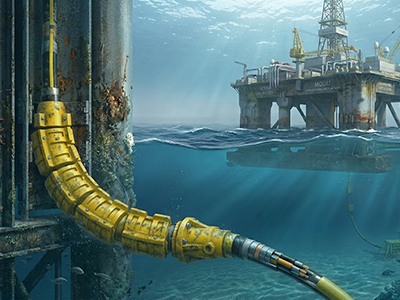
Vertebrae Bend Restrictors (VBR): Named for their interlocking, chain-like structure resembling a spinal column, VBRs consist of multiple hollow, interlocking polyurethane (PU) segments. Their core advantage lies in the "locking" mechanism: when external loads cause the cable to bend to the design-specified MBR, the segments engage tightly, forming a smooth, rigid arc that prevents further catastrophic bending of the cable.
Articulated Bend Restrictors: Articulated devices utilize a "male and female" universal joint linkage structure. Each segment connects via ball-and-socket joints, ensuring the overall curvature is controllable by limiting the angular deviation between each node. Compared to VBRs, articulated designs provide more refined angular movement constraints, which is advantageous in scenarios prioritizing "displacement compliance."
Core Comparison: How to Match Project Requirements?
Dimension | Vertebrae (VBR) | Articulated |
Application Focus | Static/Quasi-static subsea terminal protection (e.g., PLET connections) | Connections requiring higher flexibility or specific angle limit requirements |
Load Response | Clear locking point; suitable for high static structural stress | Stronger micro-adjustment capability in dynamic movement environments |
Material Advantages | High-performance PU; excellent corrosion and impact resistance | High modularity; design flexibility; easily customized for specific projects |
Installation/Maintenance | Popular "boltless" design; efficient and convenient | Requires specific universal structural alignment; higher precision requirements |
Industry Trends: Balancing Performance and Longevity
Currently, as offshore operations push into deeper waters and harsher sea conditions, traditional metal restrictors are being replaced by high-strength polyurethane materials. These materials provide the restrictor with near-neutral buoyancy, reducing the additional load on subsea structures.
For engineering teams, the choice depends on the balance between "installation efficiency" and "structural load." Vertebrae bend restrictors, with their mature modular design and excellent installation robustness, dominate the protection of offshore wind power cable joints. Meanwhile, for sensitive structures or precision deep-water connections requiring specific complex geometric displacements, articulated designs often provide more tailored constraint paths.