What is a Bend Stiffener and its Role?
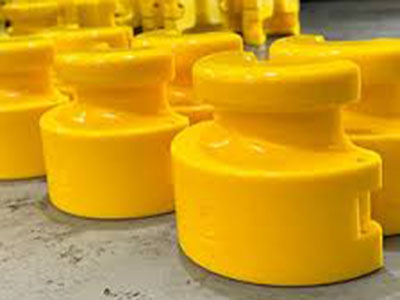
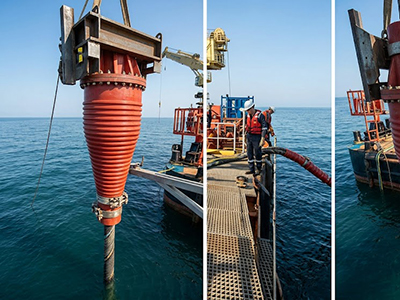
A Bend Stiffener is a conical-shaped component manufactured from high-grade elastomeric materials. It is designed to be installed over flexible pipes, cables, or umbilicals at the point where they connect to a rigid structure (such as a platform, wellhead, or J-tube).
The device features a tapered profile—thickest at the base and narrowing towards the tip—which allows for a gradual transition in stiffness along its length. At the mounting end, a steel internal flange is typically integrated (molded) into the polyurethane body to ensure a secure bolted connection to the supporting structure.
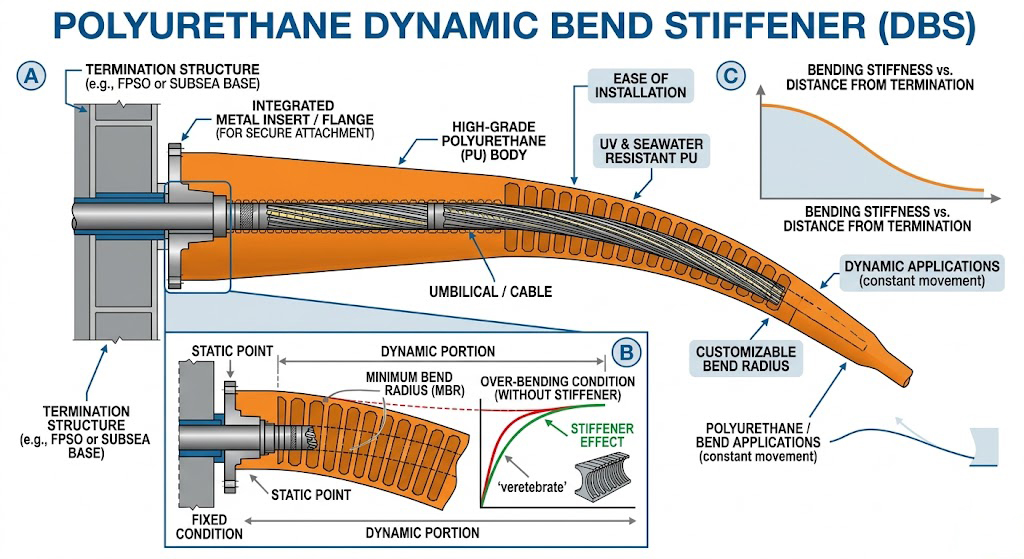
Working Principle: Stress Transition
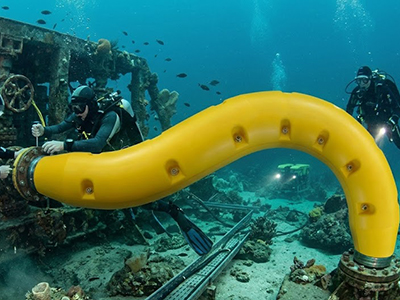
The primary function of a bend stiffener is to manage stress distribution. In offshore environments, dynamic loads from waves and currents cause constant movement. Without protection, the interface between a flexible cable and a rigid structure would become a "stress concentration point," leading to sharp bending and premature fatigue failure. The bend stiffener acts as a "buffer," providing a smooth transition from the rigid connection to the flexible span. It ensures that the cable’s bending radius never falls below its Minimum Bend Radius (MBR), effectively preventing kinks and structural damage.
What Material is Used in Bend Stiffeners?
Superior performance in subsea conditions requires specialized materials. Most high-performance bend stiffeners are made from polyurethane (PU) elastomers, specifically formulated for:
1. Exceptional Fatigue Resistance: Capable of withstanding millions of dynamic bending cycles over a 20+ year service life.
2. Hydrolysis Resistance: Stable chemical properties even after decades of immersion in seawater.
3. Customizable Stiffness: The material's hardness can be adjusted based on specific project requirements and environmental loads.
4. High Load-Bearing Capacity: Formulated to handle the extreme tension and compression found in deep-sea applications.
Key Applications
Bend stiffeners are primarily used in dynamic offshore applications:
1. FPSO/FSO Units: Protecting the top end of risers and umbilicals connected to floating vessels.
2. Offshore Wind: Safeguarding array and export cables at the entry point of turbine foundations.
3. Subsea Equipment: Protecting umbilical terminations for ROVs and subsea manifolds.
What is the Difference Between a Bend Stiffener and a Bend Restrictor?
Feature | Bend Stiffener | Bend Restrictor |
Primary Function | Stress Transition: Provides continuous stiffness to smoothly distribute bending stresses. | Mechanical Stop: Locks at a pre-defined angle to physically prohibit further bending. |
Environment | Dynamic: Ideal for applications subjected to constant motion from waves and currents. | Static / Quasi-Static: Suitable for seabed connections or protection during the laying/installation phase. |
Structural Design | Monolithic: A smooth, one-piece tapered sleeve with a diminishing wall thickness. | Modular: Consists of multiple interlocking "vertebrae-like" half-shell units bolted together. |
Working Principle | Material Elasticity: Achieves a gradual transition in stiffness through its geometric profile. | Mechanical Locking: Relies on mechanical locking points between segments to create a rigid limit. |
Core Material | High-performance Polyurethane (PU) Elastomer with an internal steel mounting flange. | High-impact Polyurethane or composite materials with stainless steel fasteners. |
Typical Applications | FPSO riser connections, offshore wind turbine foundations, and ROV umbilical terminations. | Subsea cable joints, J-tube exits on the seabed, and protection during pipeline deployment. |
Visual Appearance | Resembles a smooth "conical horn" or a flexible protective neck. | Resembles a "mechanical spine" or "skeleton" wrapped around the cable. |
Conclusion:
Simply put, Bend Stiffeners manage stress transition in dynamic environments, while Bend Restrictors enforce safety limits in static configurations. Together, they form an indispensable safety system in modern offshore engineering, ensuring the continuous and stable flow of energy from the deep sea to the surface.