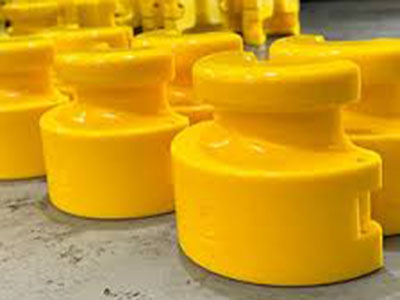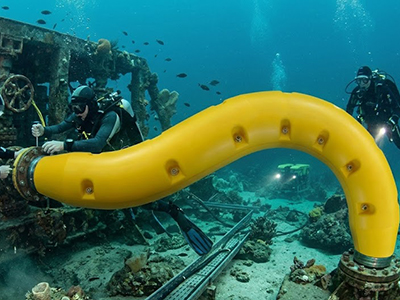
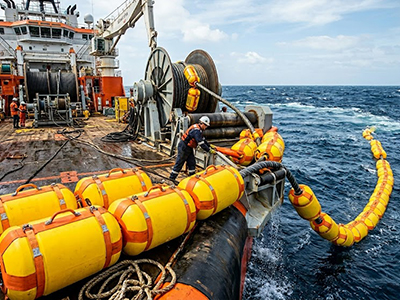
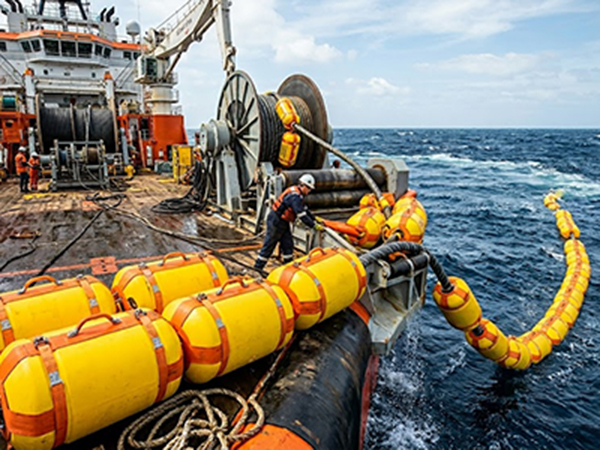
Buoyancy Modules for Drilling Riser are critical components in offshore engineering. By providing controlled buoyancy to offset the riser's self-weight, they ensure the structural stability and operational safety of the drilling system in complex marine environments.
Core Functions and Arrangement
Buoyancy modules are typically installed on the exterior of the riser in a "sleeve-type" configuration, forming either a continuous or segmented support system.
1. Balanced Distribution: The wrap-around design ensures that buoyancy acts uniformly on the pipe string, providing comprehensive geometric stability.
2. Attitude Control: They prevent the riser from bending, sinking, or tilting due to its own gravity or external flow fields (such as ocean currents).
3. Drag Reduction: The exterior is often cylindrical or streamlined. This maximizes buoyancy while minimizing hydrodynamic drag and suppressing Vortex-Induced Vibration (VIV).
4. Flexible Configuration: Depending on the operating depth and load requirements, they can be deployed in full-coverage or staggered patterns.
Material Advantages: Why Polyurethane?
In extreme deep-sea environments, Polyurethane (PU) is the preferred material due to its unique physicochemical properties:
1. Superior Weather Resistance: Excellent resistance to seawater corrosion, impact, and abrasion ensures a service life spanning decades.
2. Extreme Environment Adaptability: It maintains stable performance under high-pressure and low-temperature conditions without physical degradation or significant deformation.
3. High Strength-to-Toughness Ratio: Combining high strength with specific elasticity, it can absorb kinetic energy from impacts during installation and maintain structural integrity as hydrostatic pressure changes with depth.
Structural Design and Engineering Challenges
To address the complexities of deep-water operations, buoyancy module design follows these principles:
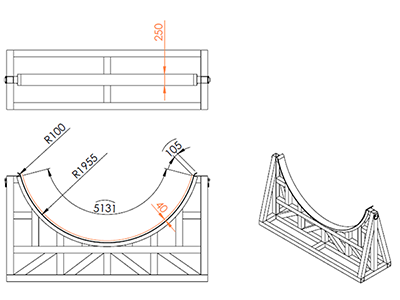
1. Modular Design: Utilizing a bolt-on, multi-segment structure greatly facilitates transportation, installation, and maintenance. It also allows for customization across different pipe diameters.
2. Pressure Compensation and Sealing: Design must account for the effects of deep-water hydrostatic pressure on material density to prevent buoyancy loss due to excessive compression.
3. Hydrodynamic Optimization: Streamlined external profiles are key to reducing transverse loads and improving the overall stability of the riser system.
Summary
As an indispensable technology for modern deep-water drilling, polyurethane buoyancy modules do more than just enhance safety and stability. Through superior material science and structural engineering, they optimize the overall mechanical performance of offshore equipment, serving as a vital safeguard for humanity's advancement into the deep ocean.