How Non-skid PU Liners Secure Wind Towers During Transit
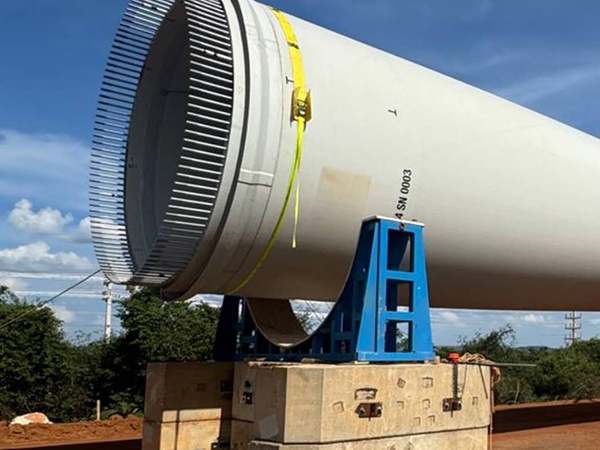
As wind farms venture into high-altitude regions and deep-sea territories, the dimensions of wind turbine towers are pushing the physical limits of logistics and transportation. These giant components, with diameters exceeding 7 meters and weights in the hundreds of tons, face a dual threat: the risk of physical displacement and the high stakes of a "coating defense war." To counter these challenges, the industry is increasingly turning to specialized Polyurethane (Pu) Liners & Pads—the invisible backbone of secure, non-skid and anti-slip transit.
Transport Risks: Preventing Coating Damage and Displacement
The cost of a wind tower is immense, and its surface anti-corrosion coating directly determines the unit's operational lifespan. During transportation, towers face a dual challenge:
1. Inertial Impact: The starting and stopping of transport vehicles or the heavy pitching of vessels can easily lead to tower displacement, posing a risk of capsizing.
2. Rigid Collision: If a metal tower is placed directly onto a steel cradle, its massive self-weight can instantly crush the coating or even cause physical deformation of the base material.
Meanwhile, traditional protection parts are failing to meet the rigorous standards for ultra-heavy towers. Wooden blocks tend to shatter under high pressure, inducing rollovers; ordinary rubber often adheres to or tears the coating in high temperatures; and centrifugal forces lead to "hard-on-hard" friction that scratches the surface.
Core Solution: The Advantages of PU Elastomer Liners
To overcome these challenges, the industry is pivoting toward customized high-molecular polyurethane (PU) elastomer pads.
1. Vibration Damping: Through a high elastic modulus, polyurethane liners achieve a perfect wrap-around fit with the outer curvature of the tower the moment they bear the weight. They act like a giant suction cup, locking the tower onto the support cradle. Even when vehicles navigate bumpy roads or ships encounter side waves, the pads absorb kinetic energy through micro-deformations and quickly reset, ensuring the tower remains centered and eliminating the risk of falling.
2. Impact Absorption: For expensive anti-corrosion coatings, non-skid pads provide a non-marking environment. Their excellent chemical stability ensures they do not react with the paint under extreme temperature fluctuations. This soft support replaces rigid fixing, allowing the tower to travel thousands of kilometers as if wrapped in a sponge, achieving true zero-scratch delivery.
3. High-Friction & Non-Skid: Protective polyurethane liners provide a superior coefficient of friction that creates a high-traction interface. This non-skid surface firmly locks the tower in place, preventing any lateral sliding caused by centrifugal forces or steep inclines. By ensuring the load remains perfectly centered, these high-friction pads provide a stable, slip-free foundation for even the heaviest wind tower sections.
Conclusion
As wind power infrastructure construction accelerates globally, transportation safety has become the "lifeline" of project commissioning. By introducing high-molecular elastomer protection systems, we are building an invisible "airbag" for these cornerstones of green energy, ensuring that these hundred-ton giants cross mountains and seas to arrive in pristine condition.