• By Philson
  • 563 Hits
  • 26-Jan,2026

Cast Iron VS Polyurethane Bend Restrictor

In offshore, subsea, and heavy industrial operations, Bend Restrictors are critical components designed to protect cables, umbilical lines, and flexible pipes from over-bending and mechanical fatigue. Choosing the right material—Cast Iron or Polyurethane (PU)—is essential for ensuring long-term structural integrity.

This guide provides a comparative analysis of both materials to help you determine the most suitable solution for your specific application.

Cast Iron Bend Restrictor

1. Cast Iron Bend Restrictors: Strength for Extreme Loads

Cast iron remains a traditional choice for heavy-duty applications where maximum structural rigidity is non-negotiable.

Key Advantages

Superior Rigidity: Provides a definitive mechanical stop to ensure cables never exceed their Minimum Bend Radius (MBR) under extreme tension.

High Thermal Stability: Exceptional resistance to high temperatures, making it ideal for industrial processes involving steam or thermal processing.

Abrasion Resistance: Highly durable in environments with high-velocity sediments or constant contact with jagged seabed rock.

Customizable Corrosion Protection: Can be enhanced with Hot-Dip Galvanization (HDG) or epoxy coatings to withstand harsh marine atmospheres.

Disadvantages

High Self-Weight: The density of iron complicates logistics and installation, requiring heavy lifting equipment or specialized ROVs subsea.

Material Brittleness: Unlike polymers, cast iron lacks impact toughness and may crack under sudden, violent mechanical shocks.

Total Cost of Ownership: While the unit price may be competitive, the cumulative costs of shipping, handling, and corrosion maintenance can be higher.

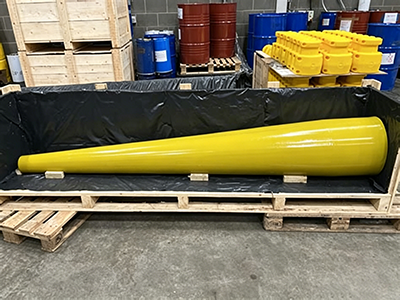
2. Polyurethane Bend Restrictors: The Modern Offshore Standard

High-performance Polyurethane (PU) has revolutionized subsea protection due to its versatility, corrosion immunity, and ease of deployment.

Key Advantages

Impact Absorption & Memory: PU is resilient; it absorbs kinetic energy and returns to its original shape without damaging the internal cable or hose.

Inherent Corrosion Resistance: Naturally immune to seawater, oxidation, and a wide array of industrial chemicals, eliminating the need for sacrificial anodes or coatings.

Lightweight Efficiency: Significantly lower density than metallic alternatives reduces the overall load on the piping system and simplifies manual or robotic installation.

Tailored Hardness: Formulations can be adjusted (Shore Hardness) to provide the exact balance of flexibility and support required for dynamic or static loads.

Disadvantages

Thermal Limitations: Physical properties may degrade in environments exceeding 80°C to 100°C.

UV Sensitivity: Without proper stabilizers, long-term exposure to direct sunlight can lead to surface degradation (photo-degradation).

3. Comparison Matrix

Performance Metric

Cast Iron

Polyurethane (PU)

Structural Behavior

Rigid / Non-flexible

Tough / Elastomeric

Impact Resistance

Low (Brittle)

Excellent

Weight

Heavy

Lightweight

Corrosion Resistance

Requires Coating

Naturally Immune

Heat Resistance

Excellent

Moderate

Installation Effort

High (Requires Cranes)

Low (Easily Handled)

Conclusion: Which Material Should You Choose?

The decision between cast iron and polyurethane should be driven by the operational environment and deployment depth:

Specify Cast Iron if: Your project involves extreme temperatures, requires a completely rigid mechanical stop, or operates in highly abrasive mining/slurry environments.

Specify Polyurethane if: You are working in offshore/subsea environments, require rapid installation, need to minimize system weight, or are protecting sensitive fiber-optic cables where vibration dampening is required.

Need a custom engineering analysis for your project?

Our technical team can help you calculate the required bending moments and specify the ideal material for your assets.  [Request a Quote]