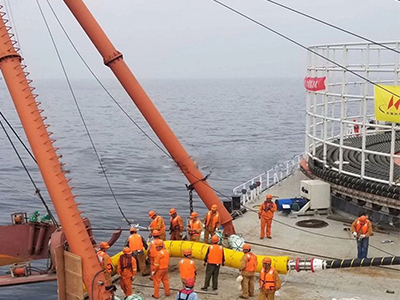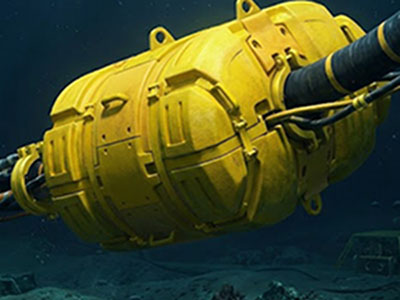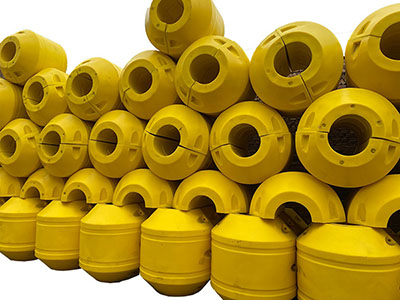
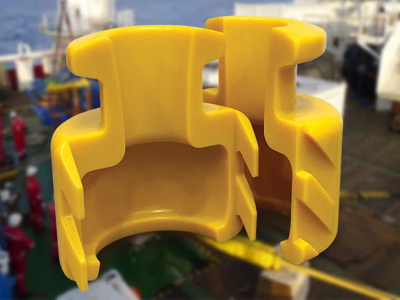
The Boltless Bend Restrictor is a revolutionary protection device for cables and pipelines within the offshore engineering sector. Unlike traditional restrictors that rely on extensive bolting, the BBR utilizes an innovative locking mechanism that significantly enhances operational efficiency.
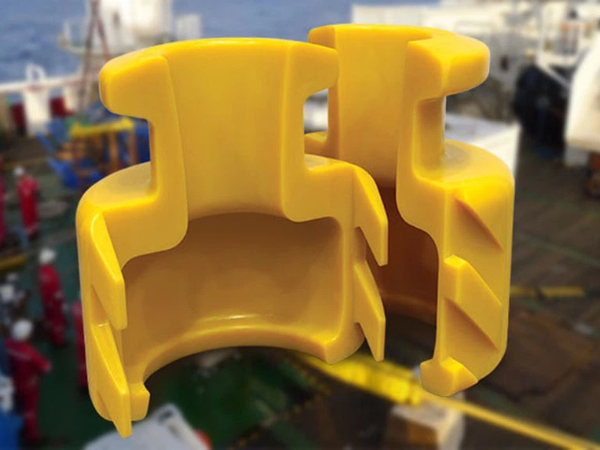
Product Definition & Core Functions
A Boltless Bend Restrictor typically consists of a series of interlocking rigid segments, often referred to as Vertebrae.
1. Prevention of Excessive Bending: When cables, fiber optics, or flexible pipelines are subjected to currents, waves, or pulling forces, the BBR limits the bending radius to a predefined Minimum Bend Radius (MBR) through the mechanical interlocking of its segments.
2. Static Protection: It is primarily used to protect pipelines in static or semi-static conditions at seabed touchdown points, riser connections, or within confined spaces.
Core Advantages
Boltless Design: Traditional restrictors may require 4–8 bolts per segment, leading to hundreds of components for a full system. The boltless design typically employs snap-fit, slide-in, or pin-locking structures.
1. Reduced Labor Hours: On costly cable-laying vessels or offshore platforms, this design can reduce assembly time by over 50%, significantly lowering vessel-time costs.
2. Uniform Stress Distribution: By eliminating metal fasteners, the overall structure distributes stress more evenly, avoiding failures caused by loose bolts or electrochemical corrosion.
3. Lightweight Construction: Utilizing high-performance Polyurethane and other composite materials, the system reduces underwater loads while maintaining high rigidity.
4. Corrosion Resistance: It completely eliminates the corrosion issues associated with metal bolts in high-salinity deep-sea environments.
5. Extended Service Life: Designed for offshore drilling platforms, offshore wind farms, and subsea engineering, its service life typically reaches 20–25 years.
Typical Application Scenarios
1. Offshore Wind Power: Protecting Array Cables at the entry point of wind turbine foundation towers (J-tubes/I-tubes).
2. Oil & Gas Fields: Connection points between Umbilicals and subsea Christmas trees (XTs).
3. Submarine Fiber Optics: Providing rigid support in areas with complex topography or significant seabed elevation changes.
Summary
In modern maritime engineering, "Boltless" design has become a dominant trend. Beyond fast installation, the design aligns with the logic of deep-sea ROV operations, where manipulating bolts is extremely difficult compared to simple mechanical interlocking.