Submarine cables act as the vital arteries connecting offshore energy and global information networks. In complex and unpredictable marine environments, these cables are highly vulnerable to external physical damage. Submarine Cable Articulated Pipes are engineered precisely to counter these challenges.
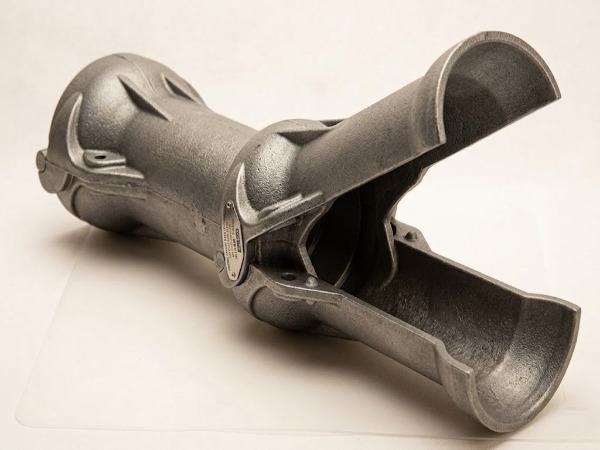
What is a Submarine Cable Articulated Pipe?
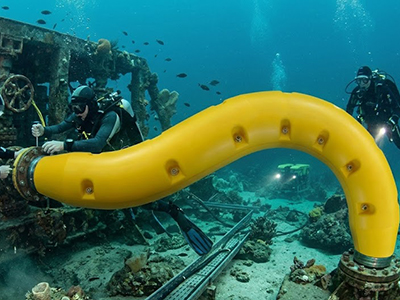
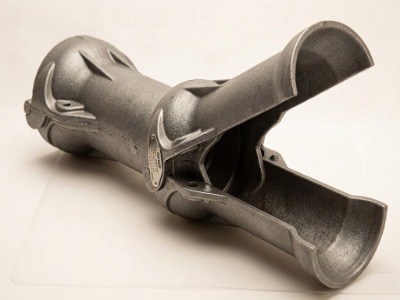
A Submarine Cable Articulated Pipe is a mechanical protection system consisting of semi-cylindrical pipe segments assembled over a cable.The system typically consists of two symmetrical half-shells that interlock via a male-female (ball-and-socket) joint. They are securely clamped over submarine power cables, fiber optic cables, or umbilical cables using high-strength bolts, nuts, and washers.
The Essence of the Articulated Design
Its uniqueness lies in its articulated ball-and-socket design. This feature grants the protection pipe a degree of bending flexibility while setting a maximum bend restriction. It allows the cable to contour to the uneven seabed during laying, while simultaneously preventing the cable from over-bending, which could rupture the internal conductors or optical fibers.
Application Environment
Articulated pipes are primarily utilized in areas where seabed burial is impossible or where the cable faces extreme risks of external mechanical damage:
1. Rocky Seabeds and Reefs: In hard-rock areas where trenching is unfeasible, cables must be laid directly on the seabed. Articulated pipes provide tough armor protection.
2. Shore-end Landings: As cables transition from deep water to land, they cross intertidal zones and shallow beaches exposed to heavy wave action, tidal friction, and sand/gravel abrasion.
3. Shipping Lanes and Anchorage Areas: Prevent cables from being snagged or damaged by ship anchors and bottom-trawling fishing nets.
4. Cable and Pipeline Crossings: Act as physical isolation and load-bearing protection when a new submarine cable crosses existing oil/gas pipelines or other cables.
5. Offshore Wind Farms (J-tube Exits): At the transition zone between wind turbine monopiles and the seabed (scour zone), protect cables from fatigue failure caused by hydrodynamic vortices and seabed erosion.
Materials
To survive in highly corrosive deep-sea and shallow-water microbial environments over a 20–30+ year design lifespan, material selection is critical:
1. Main Body: Ductile Cast Iron
- Common Grades: GGG40, GGG50, etc.
- Advantages: Exceptional impact toughness and high tensile strength vs. standard grey cast iron.
- Gravity Ballast: High density and weight anchor the cable to the seabed and prevent drifting.
2. Fasteners and Connectors: Corrosion-Resistant Alloys
- Bolts and Nuts: Stainless Steel 316L, Duplex Stainless Steel, or hot-dip galvanized (HDG)/Dacromet-coated carbon steel.
3. Surface Protection Coating
- Bitumen Coating or Epoxy Coating to further resist seawater corrosion.
Technical Parameters
| Parameter Category | Item | Typical Specification Range |
|---|---|---|
| Dimensions | Applicable Cable OD | φ30 mm – φ300 mm+ |
| Pipe Internal Diameter (ID) | φ40 mm – φ350 mm | |
| Wall Thickness | 8 mm – 15 mm (depending on impact requirements) | |
| Effective Length per Unit | 300 mm – 500 mm | |
| Mechanical Properties | Tensile Strength | ≥ 400–500 MPa |
| Yield Strength | ≥ 250–320 MPa | |
| Elongation | ≥ 7% – 15% | |
| Articulation Features | Max Angular Deflection | 5° – 15° |
| Minimum Bending Radius (MBR) Limit | Engineered to match cable MBR (e.g., 1.5 m – 3.0 m) |
Articulated pipes are custom-manufactured based on cable outer diameter (OD).
Protect Your Subsea Assets Today!
Don’t let unpredictable seabed conditions threaten your offshore network.
Contact our engineering team today to get a custom quote and technical drawing tailored to your cable diameter.