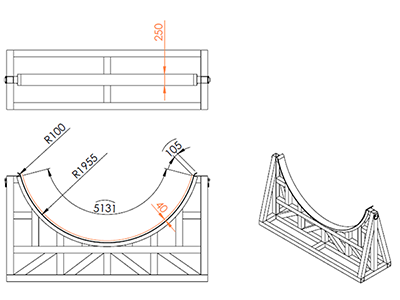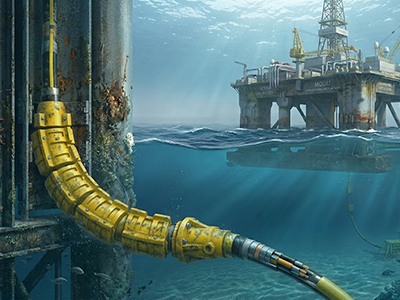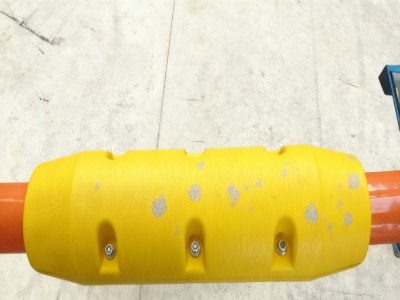
Our Bend Restrictors are mission-critical mechanical safety devices, meticulously engineered by our team to mitigate the risk of structural fatigue and premature failure in subsea cables, umbilicals, and flowlines. In the high-energy environments of the offshore and heavy engineering sectors, our systems protect subsea assets from extreme tensile stress, hydrodynamic loading, and cyclic fatigue. By physically enforcing the Minimum Bend Radius (MBR), our Bend Restrictors serve as the primary line of defense against permanent cable deformation and conductor rupture at critical connection interfaces.
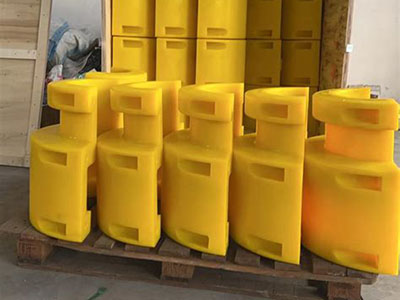
Structural Design of Bend Restrictor
Drawing inspiration from vertebrate spinal mechanics, our engineers have transformed flexible assets into controlled, predictable systems:
Modular Interlocking Architecture: We manufacture each system using precision-machined vertebrae, featuring a progressive locking geometry. As the cable reaches its design limit, the modules mechanically interlock to prevent further curvature.
Structural Load Transfer: Once fully engaged, the restrictor assumes the mechanical load, effectively shielding the internal conductors from high-tension peaks. Our design redistributes the bending moment away from sensitive interfaces.
Optimized Interface Engineering: We design our systems for high-stress transition zones, ensuring a seamless mechanical transition between rigid subsea foundations and flexible subsea assets.
Bend Restrictor Applications within Offshore & Heavy Engineering
Our solutions are engineered to meet the demanding requirements of global energy and infrastructure projects:
Offshore Wind Infrastructure: We provide critical protection for array and export cables at the J-tube exit and turbine foundation transition zones, neutralizing the effects of scour-induced vibrations.
Subsea Oil & Gas: Our systems offer secure termination protection for Subsea Trees, Manifolds, and Pipeline End Terminations (PLETs), ensuring integrity in harsh deepwater conditions.
Dynamic Asset Protection: We deliver reliable support for umbilical and flowline configurations, including mitigating risks at Free-span zones on uneven seabeds.
Installation Support: Our equipment provides essential protection for assets during complex overboarding and deployment processes from heavy-lift or cable-lay vessels.
Whether you need standardized protection or a bespoke engineering solution for a complex environment, our technical team is ready to support your project. Consult with Our Engineering Team.