Polyurethane Cable Protection for Singapore Offshore Wind
Customer
As offshore wind power generation continues to expand across Southeast Asia, regional grid developers and engineering, procurement, and construction (EPC) contractors are increasingly focused on safeguarding critical subsea infrastructure. For a recent major offshore wind farm project located in the strategically important and high-traffic maritime waters near Singapore, a leading regional clean energy infrastructure developer was tasked with installing and securing the project’s vital power transmission network. The project involved the deployment of multiple critical sections of both high-voltage power export cables and inter-array cable networks to connect the offshore wind turbines directly to the mainland grid.
Requirement
The subsea cables for this Singaporean offshore project had to be routed through a highly challenging marine environment characterized by high-velocity currents and complex, unforgiving seabed topography. A significant portion of the cable route passed through touchdown zones, J-tube transitions, and rocky, uneven seabed areas containing sharp reef formations and dense boulder fields.
Without adequate protection, the power cables would be subjected to severe, continuous abrasion caused by current-induced movement against the rocky seabed. Additionally, the project site overlapped with active commercial shipping lanes and regional fishing grounds, presenting an ongoing risk of external mechanical impact from dragging fishing gear and marine anchors.
To mitigate these risks, the client required a highly durable, resilient, and maintenance-free cable protection solution. The technical specifications demanded a system that could withstand both high-impact energy and sustained friction over a long operational lifespan. Crucially, due to unpredictable sea states and the tight schedules of specialized cable-laying vessels, the protection system also had to be exceptionally fast and straightforward to install during the limited maritime access windows.
Solution
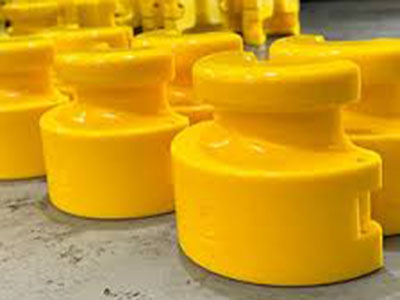
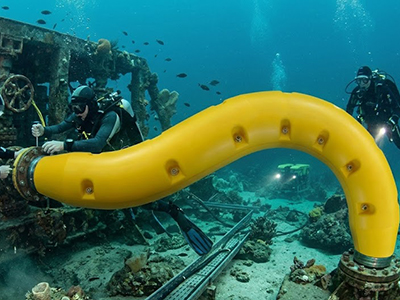
To address these severe subsea conditions, a custom-engineered modular interlocking tubular cable protection system was deployed along the high-risk sections of the export and inter-array cables. Manufactured from high-performance polyurethane elastomer, the protection tubes were precisely tailored to match the client's specific cable diameters and the project's exact structural requirements.
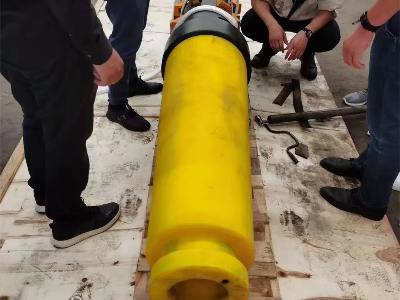
The polyurethane system was formulated to achieve a hardness range of Shore D 60, providing an optimized balance between rigid impact absorption and flexible abrasion resistance. To facilitate effortless underwater monitoring, the protection tubes were produced in high-visibility yellow, making them highly recognizable for Remotely Operated Vehicle (ROV) inspection cameras during post-installation surveys and routine grid audits.
The installation process on the vessel deck proved to be rapid and highly efficient. Utilizing a symmetrical, user-friendly clamp design, the shipboard crew was able to secure the interlocking sleeves around the cables in a matter of minutes. The assemblies were locked into place using marine-grade, high-corrosion-resistant stainless-steel strapping, ensuring the tubes remain immovably fixed to the cables under extreme hydrodynamic forces.
By utilizing this modular, ready-to-install design, the integration process was seamless, allowing the cable-laying operations to progress without any scheduling delays. The high-performance polyurethane shielding now successfully insulates the critical energy infrastructure from seabed interference, guaranteeing reliable, long-term power transmission with drastically reduced subsea maintenance overheads.