Bend Restrictor Deployment in the European North Sea
Customer
Within the demanding offshore energy corridor of Northern Europe, ensuring the absolute structural integrity of high-capacity inter-array grids is vital for uninterrupted power transmission. For a major cross-border offshore wind asset situated in the high-energy waters of the North Sea between Norway and Denmark, a leading international marine contractor was tasked with the installation and long-term stabilization of the project's subsea cable network. The infrastructure required deploying heavy-duty, large-diameter subsea cables across water depths ranging from 40 to 60 meters to link high-output turbine arrays directly to regional subsea substations.
Requirement
The North Sea environment presents some of the most hostile hydrodynamic and geological conditions in the offshore sector. For this specific deployment, the engineering challenges were intensified by both the scale of the infrastructure and the harshness of the maritime terrain:
1. Extreme Mechanical Stress on Large-Diameter Lines: The project utilized heavy-duty power cables with a significant outer diameter (OD) of 210mm. At critical static connection points, J-tube exits, and subsea cable crossings, these lines were highly vulnerable to severe stress concentration, localized fatigue, and catastrophic over-bending.
2. Unforgiving Seabed Topography and Hydrodynamics: The cable route traversed a rugged, rocky seabed swept by continuous high-velocity bottom currents and intense wave energy. Traditional metallic protection systems were deemed impractical; their excessive weight increased structural tension on the deployment vessels, and they faced severe long-term risks of galvanic corrosion in high-salinity waters.
3. Highly Restrictive Installation Windows: Due to the notoriously unpredictable and violent weather patterns of Northern Europe, the maritime access windows for cable-laying vessels were exceptionally narrow. The client required a specialized protection system that could be deployed with absolute mechanical speed and safety, minimizing expensive vessel downtime.
To ensure a continuous power supply and avoid cost-prohibitive subsea intervention over a multi-decade lifecycle, the project demanded a non-corrosive, lightweight, and mathematically precise bending control solution capable of strictly enforcing the cable's Minimum Bend Radius (MBR) under continuous dynamic loading.
Solution
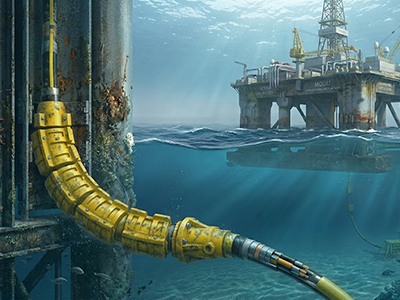
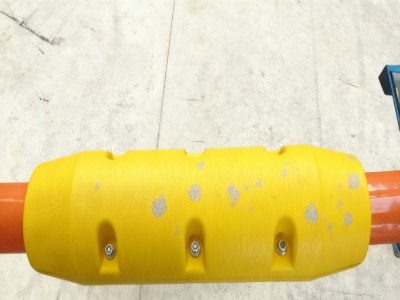
To address these critical engineering constraints, a custom-engineered Polyurethane Bend Restrictor (BSR) system was developed and deployed along the high-risk sections of the 210mm subsea cables. Engineered strictly in accordance with DNV-ST-0119 industry compliance standards, the system replaced traditional materials with a high-performance, marine-grade polyurethane (PU) elastomer.The system architecture features a series of interlocking vertebrae units precision-machined with a 215mm internal diameter (ID). This intentional 5mm clearance provides a perfect mechanical fit for the 210mm cable while crucial accommodating structural thermal expansion and contraction during peak high-voltage power transmission. Unlike steel, the marine-grade PU compound features near-neutral buoyancy to significantly reduce cable tension, offers superior resistance to marine growth, and completely eliminates saltwater corrosion.
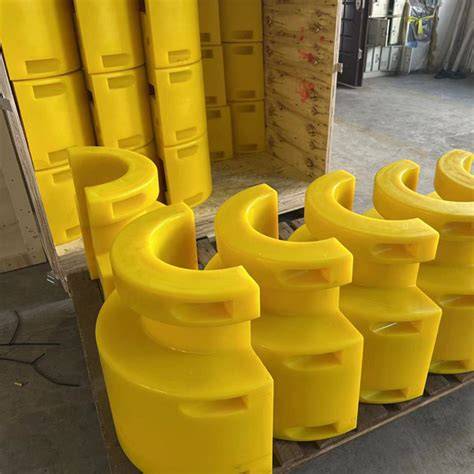
Through rigorous mechanical simulation, the interlocking vertebrae design was optimized to create an unyielding mechanical stop. When subjected to severe tidal forces, each interlocking element locks tightly against the next at a pre-calculated limit, preventing irreversible buckling and shielding the asset from structural damage.
On the vessel deck, the split-half design of the restrictor segments allowed the shipboard crew to wrap and bolt the units around the cable within minutes just prior to overboarding. Secured with high-grade 316L stainless steel and titanium fasteners, the assembly process maximized productivity during critical weather windows.