In the world of modern industrial logistics and automated equipment, the performance of the drive wheel directly determines the efficiency and safety of the entire system. The 4-Stud Polyurethane Driving Wheel has become the premier choice for AGVs (Automated Guided Vehicles), electric forklifts, and heavy-duty conveyor systems, thanks to its exceptional load capacity, wear resistance, and precision mechanical coupling.

1. Structure and Design Core
The 4-Stud configuration is a deliberate engineering choice, representing one of the most stable structures in industrial standards for balancing installation ease with high-torque transmission.
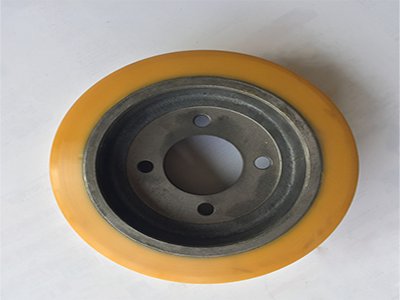
Precision Hub Structure: These wheels typically feature a high-strength cast steel or forged steel core. Four symmetrically arranged bolt holes (PCD layout) are CNC-machined to ensure that driving force is transmitted smoothly and without loss from the motor shaft to the tread.
Polyurethane Bonding Technology: Utilizing high-performance elastomers (typically ranging from Shore 85A to 95A), the polyurethane is chemically cast onto the metal core. This material offers significantly higher tear resistance and resilience compared to traditional rubber.
2. Why Choose Polyurethane (PU) Treads?
Compared to metal or rubber wheels, polyurethane driving wheels offer distinct physical advantages in industrial environments:
Superior Load-Bearing Capacity: Polyurethane has a much higher Young’s modulus than rubber, meaning it can support heavier loads without permanent deformation at the same dimensions.
Excellent Traction and Shock Absorption: The unique hysteresis properties of PU allow it to absorb vibrations from uneven floors while providing a high coefficient of friction, preventing slippage during rapid acceleration or braking.
Non-Marking and Silent Operation: Unlike cast iron wheels, PU operates with minimal noise and will not damage epoxy floors or leave unsightly black skid marks.
Chemical and Oil Resistance: PU is highly resistant to common industrial lubricants, greases, and many acidic or alkaline solvents.
3. Typical Application Scenarios
Due to the versatility of the 4-stud mounting, these driving wheels are widely utilized in:
AGVs and AMRs: In smart warehousing, the 4-stud connection allows for direct coupling with motor gearboxes, ensuring high-frequency, high-precision start-stop cycles.
Electric Pallet Jacks and Forklifts: Serving as the primary drive wheel to provide reliable traction in narrow warehouse aisles.
Automated Assembly Lines: Used in friction drive systems (EMS) for automotive or appliance assembly lines to ensure steady, synchronized transport.
4. Key Technical Selection Criteria
When sourcing or customizing 4-stud polyurethane driving wheels, pay close attention to these engineering details:
Key Parameter | Description |
PCD (Pitch Circle Diameter) | The diameter of the circle passing through the center of the 4 bolt holes; must match the motor flange exactly. |
Shore Hardness | Typically 90A-95A. Higher hardness increases load capacity but slightly reduces grip. |
Dynamic Load | Must account for impact loads during movement; a safety factor of 1.5x is usually recommended. |
Core Protection | For humid environments, an electrophoresis or galvanized coating on the metal core is advised. |
5. Conclusion
A 4-stud polyurethane driving wheel is more than just a rolling component; it is the bridge of industrial power transmission. By combining high-strength metal with advanced elastomers, it plays an irreplaceable role in extending equipment life, reducing maintenance costs, and protecting work floor surfaces. [Contact Our Engineers Today] to receive a tailored technical consultation.